Silver as a Byproduct of Copper Mines: The Supply Story
Much of the world's silver is mined not because miners want silver, but because they want copper — so today's tariff-driven dollar story matters less for silver's price than for the copper mines that produce it.
- Silver spot sits at $4,060.50, down 2.08% on the day and 23.6% below its 52-week high of $5,318.40
- The Silver Risk Index reads 5.25 (neutral) from 2,709 stories, with geopolitical risk — not the dollar — the strongest single channel
- After past one-day falls of this size, silver has historically traded higher 53–56% of the time over the following 5–20 sessions
Today's dollar story is not the silver supply story
Eleven headlines crossed the wires today, and ten of them are variations on the same theme: the US dollar is holding firm near 101.00 on the dollar index as investors digest new tariffs and Middle East risk. A stronger dollar makes silver more expensive for foreign buyers, which is the mechanical reason today's index reading leans mildly bearish. But if you searched for silver as a byproduct of copper mines, you're asking a different, better question — one about where the metal actually comes from, and it barely touches the dollar at all.
Most silver is not mined for silver
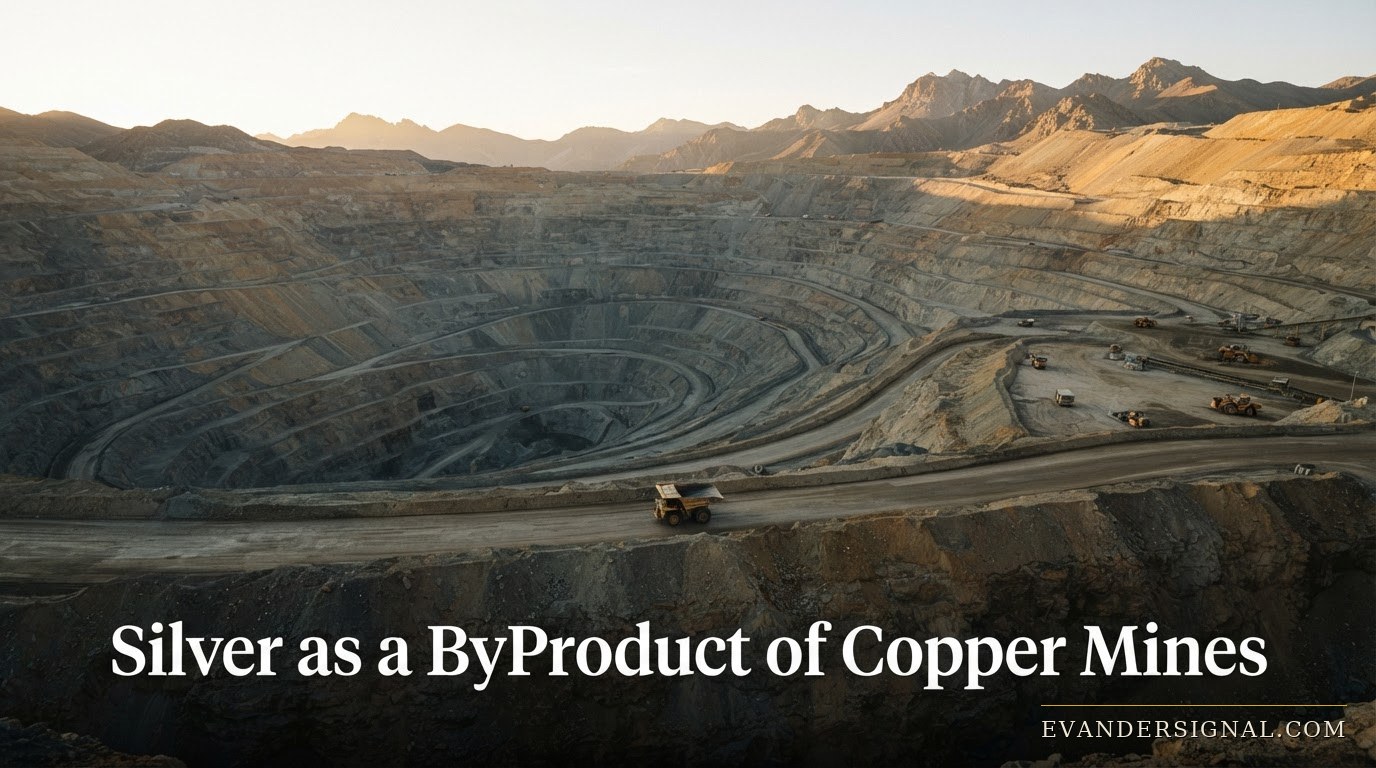
A large share of the silver dug up each year is not the primary target of the mine that produces it. It comes out of the ground as a byproduct of mining copper, lead and zinc — metals that justify the capital cost of the mine on their own economics. That matters enormously for how silver supply behaves. A copper mine doesn't ramp production up or down because the silver price moves; it responds to copper prices, ore grades and capex decisions taken years in advance. Silver supply tied up in that chain is, in effect, hostage to a different market's cycle.
This is why today's tariff noise is relevant, just not in the way the headlines frame it. Trade policy that disrupts industrial metal flows, raises input costs, or delays mine investment feeds through — with a lag — to the byproduct silver stream, independent of anything happening to the silver price itself. None of today's eleven stories describe a copper mine cutting output; they describe currency and trade politics. But the mechanism worth watching, if tariff escalation continues, is whether it touches copper project economics, not just the exchange rate.
What the measurement says today
The Silver Risk Index reads 5.25 out of 10 — neutral — built from 2,709 weighted stories with full evidence coverage. Notably, the strongest channel driving that reading right now is geopolitical risk, not the dollar, even though dollar-related stories dominate today's headline count. The index has only three days of live history, too short to say it has any predictive track record, so treat the reading as a snapshot of current sentiment rather than a signal.
What the price record shows
Silver is trading at $4,060.50, down 2.08% on the day, up 1.88% over the past week, down 2.90% over the month, and up 22.40% over the year. That puts it 23.6% below its 52-week high of $5,318.40, with 30-day realised volatility running at 27.3% annualised — a reminder that swings of this size are not unusual for this metal.
Today's fall is close to the threshold the measured history uses to define a down-shock day (a one-day move worse than -1.77%). After such days historically, silver traded higher five sessions later 53% of the time, with a median move of +0.22%, and higher 56% of the time after 20 sessions, with a median move of +0.63%. These are modest, historical tendencies from 323-325 prior instances, not forecasts for what happens next.
What would change the picture
The byproduct story only becomes a near-term price story if tariff escalation starts hitting copper mine investment or output directly, tightening the silver supply that rides alongside it. Absent that, today's dollar strength is the dominant mechanical driver, and the index's neutral 5.25 reading reflects a market where geopolitical risk and currency effects are roughly offsetting each other rather than pointing firmly one way.
- SVDollarn stark medan investerare bedömer nya USA-tariffer och Mellanösternrisker - Invezz — gnews:dollar_index:SE:sv
- ENTrump’s latest ‘forced labour tariffs’: Who’s been hit, how badly? — aljazeera
- ENNEWSLETTER: Section 301: the latest sequel in Tariff Man’s trade crusade - Reuters — reuters_via_gnews
- ENTrump sued hours after new tariffs take effect, as experts say they may not hold up — cnbc_world
- ZHBitget UEX Daily Report | New US tariffs come...|Bitget, Federal Reserve - 链捕手ChainCatcher — gnews:Federal_Reserve_interest_rates:GB:en
- ENThe next phase of Trump’s trade war — ft_home
- ENDollar holds firm as investors assess new US Tariffs and Middle East risks - Invezz — gnews:dollar_index:US:en
- DEDollar bleibt robust, Anleger prüfen neue US-Zölle und Nahost-Risiken - TradingView — gnews:dollar_index:CH:de